UX · UI · Product Design 2025
HALO

Be on the same wavelength. Reconnecting people through the music playing around them.

78% Listen alone
2.3h Daily solo use
360° Signal range
SPICY CHAOS
152°
Scroll

Music became
a private experience.

There was a time when music gathered people. Today, earphones have turned it into a personal bubble, the boombox replaced by a stream only you can hear.

Then · Boombox era
Music as a social anchor
Now · Earphone era
Music as a personal bubble
78%
Always listen alone in public Among 18–28 year olds surveyed in public spaces: transports, parks, streets
2.3h
Average daily headphone use Of daily music listening time spent entirely alone, without sharing or knowing what others hear
63%
Never share what they're listening to Say discovering shared musical taste was a strong social trigger, but only when music was made audible
14%
Deliberately chose not to play music around others Only 14% of respondents regularly play music for others in shared public or semi-public spaces

Who we designed for.

Three archetypes emerged from 34 user interviews conducted with students and young adults in Lyon.

BL
The Kitchen DJ
Blandine, 24

"We used to fight over the kitchen playlist. Now everyone just uses their own earphones. The kitchen feels emptier somehow."

3.5hmusic / day
3flatmates
0communal music rituals left
"over a year ago"last shared listening
Music rituals vanished from shared living
Restore the kitchen as a communal sonic space
KI
The Signal Seeker
Kilian, 19

"I always notice people who seem to be listening to something good. I can tell by how they move. But there's no way to cross that invisible wall."

4.2hmusic / day
1h30metro daily
~7×Shazam / week
Oftenchecks others' visible screens
Proximity to interesting music, zero access to it
Discover music through human proximity, not cold algorithm
The Ambient Architect
Céleste, 29

"When I host, the playlist is as important as the food. But lately everyone disconnects into their own stream. My atmosphere collapses."

2.8hmusic / day
hosts / week
12kSpotify curator followers
Open officeworker
Curated music environments fall apart when individuals opt out
Design shared sonic atmospheres that people choose to enter

Reading between the silences.

Observation reveals behaviors users couldn't articulate. Four field signals shaped the final design direction.

Observed behavior

9/12 cited offering one earbud as their most intimate music memory, but said they "never share music anymore"

Hidden signal

The physical half-share is the most profound musical gesture. HALO replaces the wire, not the intimacy.

Observed behavior

All participants instinctively lowered volume when someone entered their space, even mid-sentence during interviews

Hidden signal

Social music anxiety is automatic. The solution must eliminate imposition, not fight it.

Observed behavior

Kitchen was unprompted by 11/12 as the last surviving shared music space. No one mentioned commute or office.

Hidden signal

Music sharing endures only within shared rituals. HALO must attach itself to rituals, not disrupt them.

Observed behavior

Groups of strangers in transit who shared musical tempo unconsciously synchronized subtle body language

Hidden signal

Invisible resonance already exists. HALO makes it readable and connectable.

The emotional arc of a music moment.

Mapping the moments where human musical connection is possible, and currently missed.

WAKE COMMUTE WORK LUNCH COMMUTE HOME EVENING Isolated bubble Missed signal OPPORTUNITY OPPORTUNITY +
Solo experience Shared experience Active Passive Spotify Apple Music Shazam Jukestar Aux cable HALO
Competitive positioning
Existing players
HALO / active + shared
The gap

No existing tool combines active participation with genuine shared experience. HALO occupies this open quadrant.

Design principle

Passive sharing (like Shazam) requires no gesture. HALO requires intentional orientation, making the connection felt, not tracked.

What people
told us.

We interviewed students and young adults about their relationship with music in public and shared spaces. Four recurring patterns emerged.

I listen to music all the time on public transport but I never know what people around me are listening to. Sometimes I wish I could just... peek.

T
Thibaut, 22
Architecture student

The only moment I share music is when I cook with friends. The kitchen is the one room where music is still communal. It feels different.

R
Rémi, 24
Design student

AirPods are a social barrier. I see people I'd love to talk to but with their earphones in I don't know how to break the ice, music could be that bridge.

J
Judith, 21
Design student

I remember my dad putting music on for everyone in the kitchen every morning. Today I just put on a podcast alone. Something feels missing from that ritual.

G
Gautier, 23
Design student
Kitchen Most cited space
for shared music
#1 Music as top
conversation starter
4/4 Interviewees wanted
non-invasive sharing
Solo Cooking cited as the
loneliest daily moment

Point. Tune in.
Connect.

Halo uses your phone's compass and gyroscope to detect who is casting music around you, and let you tune in to their signal by physically pointing your device toward them.

Slow Roast
Spicy Chaos
Sweet Baking
Cold Cut
Melancholic Stew
01
Cast your music Toggle "broadcasting" in the app to let others discover what you're listening to. They don't see your exact location, only your compass direction.
02
Signals appear on the radar Coloured dots appear around you, one per person currently casting. Each sits at its real geographic bearing: east, south, northwest.
03
Rotate to tune in Hold your phone in landscape mode and physically rotate toward a dot. When the crosshair aligns, signal locked. The sound waves take on their colour.
04
Listen together, anonymously No profile, no follow, no message. Just a shared listen. The person casting doesn't know who tuned in. The connection is felt, not tracked.
Hover a signal to tune in
SLOW ROAST
Post-Rock · 221°
SWEET BAKING
Pop · 098°
ANGRY FRYING
Punk · 042°
COLD CUT
Jazz · 180°
SPICY CHAOS
Electronic · 152°
MELANCHOLIC STEW
Shoegaze · 310°

Sketching
the totem.

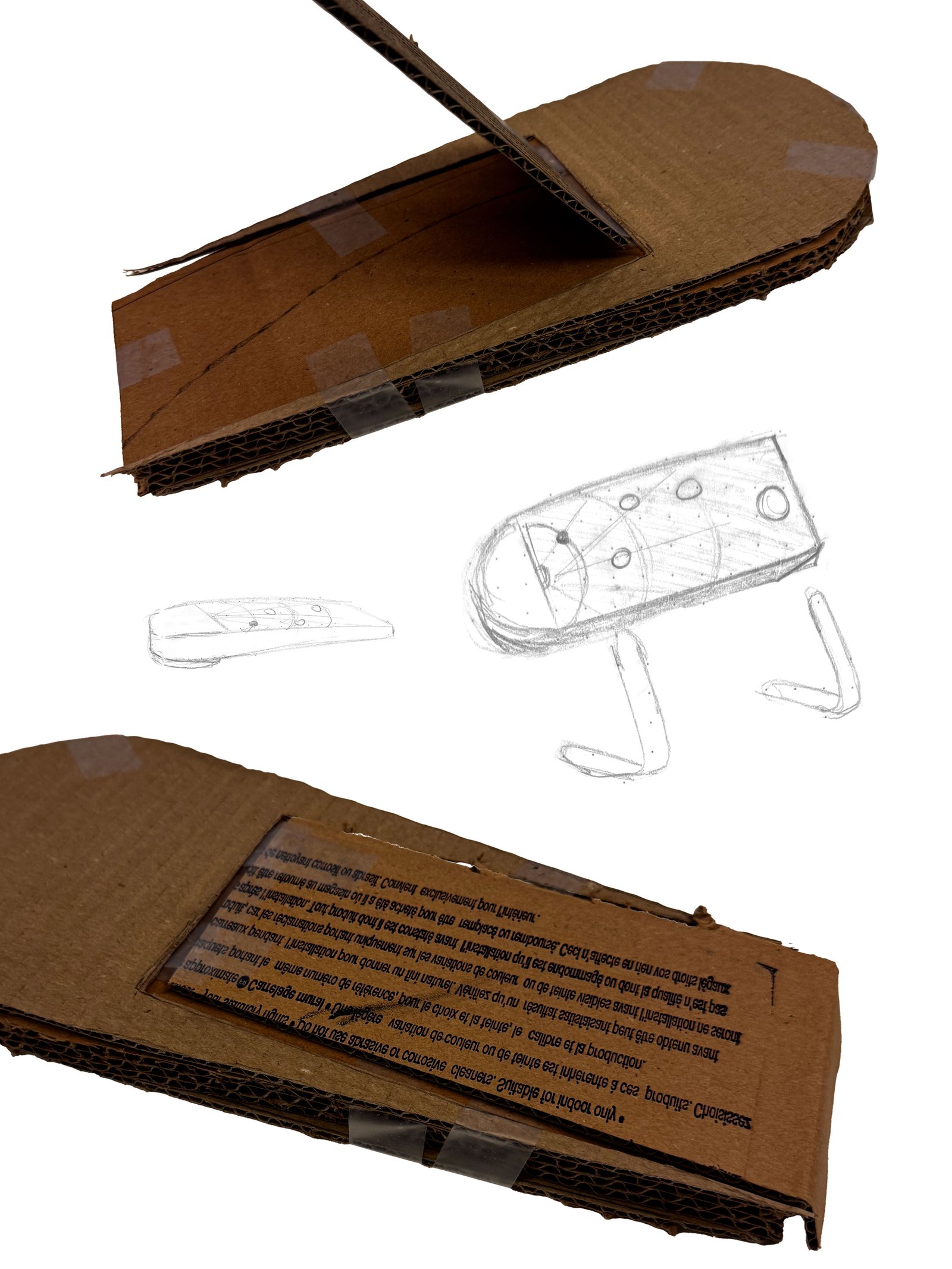
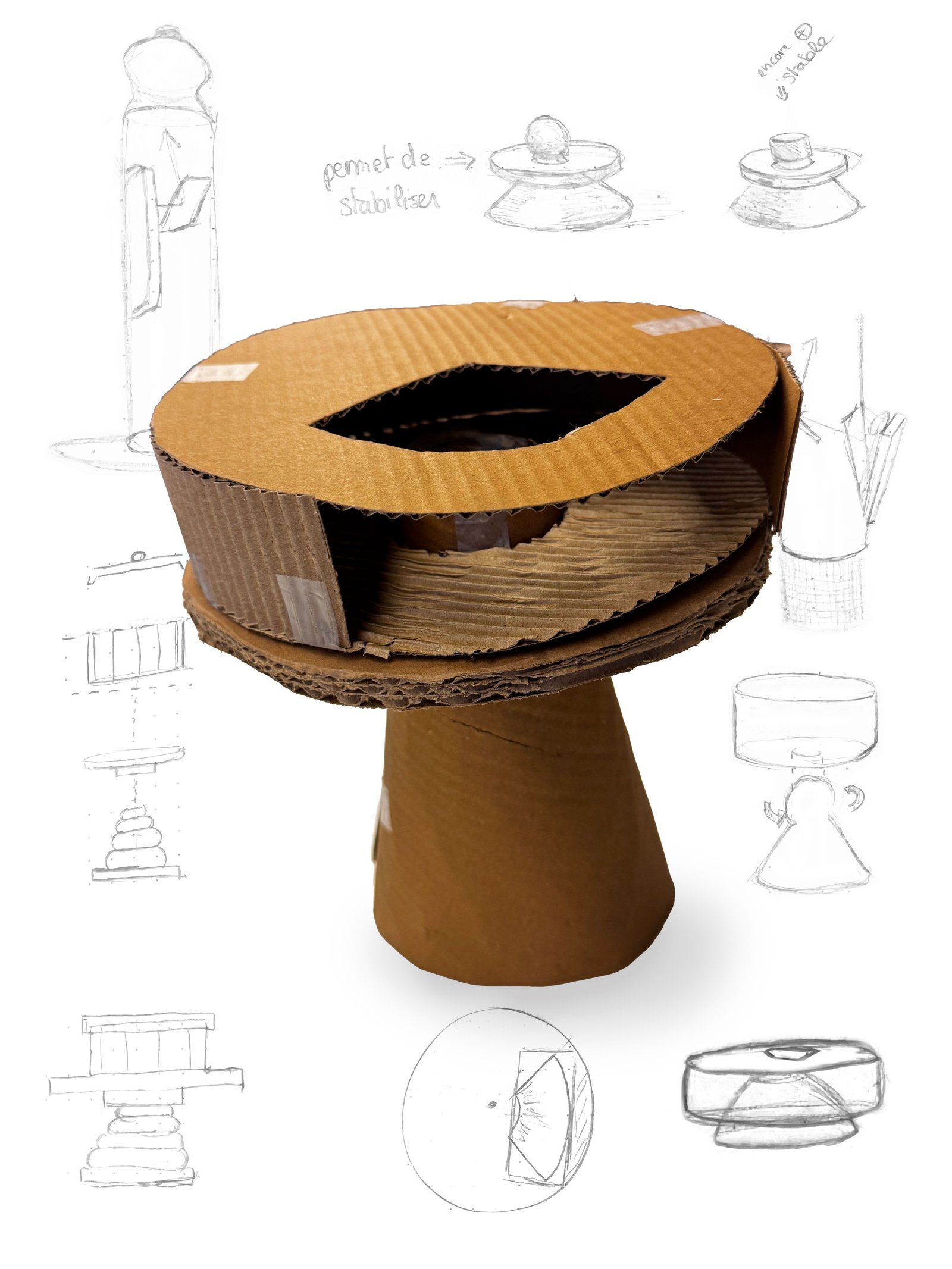
Early form studies, material tests, and structural sketches for the physical object. Finding how a phone stand becomes a compass.
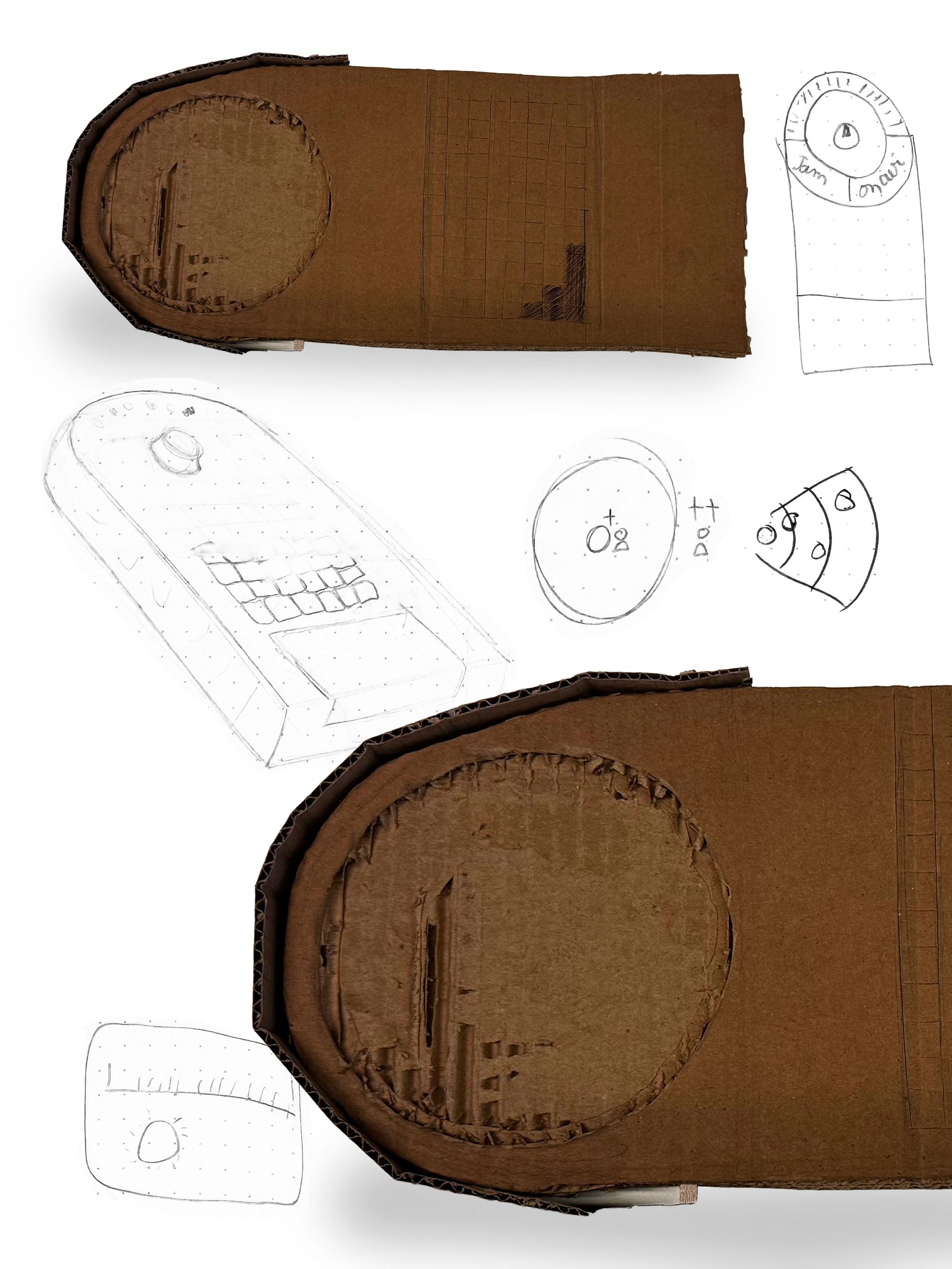
Totem sketch 1
Totem sketch 2
Totem sketch 3
Totem sketch 4

A totem for
the kitchen.

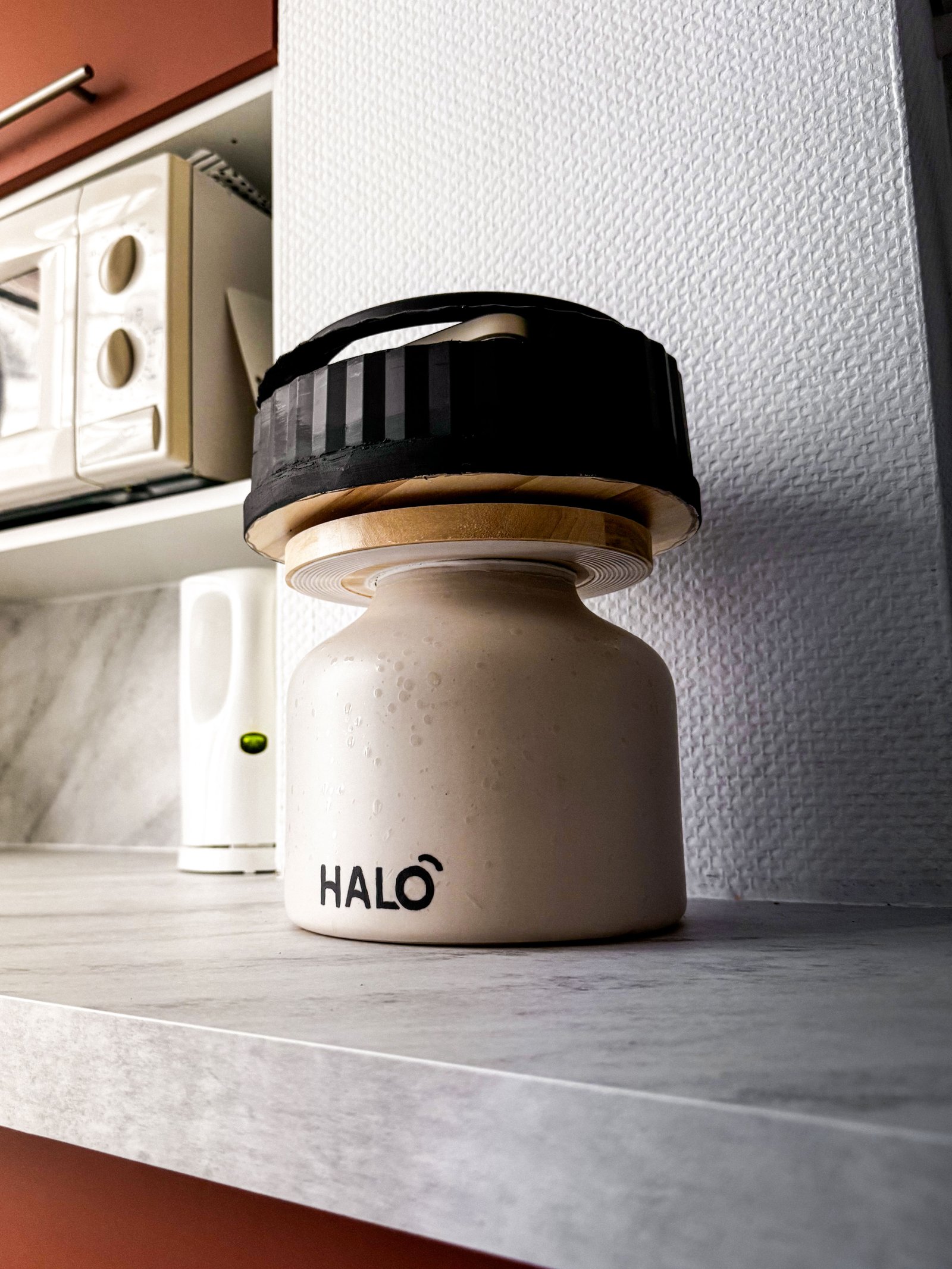
Halo lives in the loneliest moment of daily life: cooking alone. The physical totem places your phone at eye level, its rotating cap lets you aim with an elbow, a wrist, the back of your hand.

01
Hands-free manipulation The rotating cap is designed to be turned with the back of the hand, the elbow, or the wrist. Because when you cook, your hands are never clean.
02
The phone becomes a compass Placing your phone in the totem aligns it with the rotating mechanism. Turning the cap turns the phone, and therefore the Halo direction sensor.
03
Context-aware design The kitchen is the most intimate semi-public space. The totem is small, stable, and neutral. It belongs on a counter the way a speaker or a lamp does.
04
Ritual over interaction The physical act of rotating toward someone's signal turns a digital action into a real gesture. It's the closest thing to tuning an old radio: deliberate, tactile, human.

The app
in images.

Final app screens, from the live radar view to the signal-locked state. Sound waves react to the music's energy in real time.
Halo screen 1
Halo main screen
Mockup
QR Validation
Halo QR
Try the prototype
Scan to open the Halo demo
Requires iOS device with compass
Concept Art · v.2

Hear the same project,
told differently.

An experimental concept-art version of Halo. Same project, narrated through waves, color, and the invisible crowd around you.

Enter Concept Art