An AI-driven medieval escape adventure for any space, anywhere. Where every dungeon is written the moment you enter it, and no two players ever solve the same chamber.
Physical escape rooms tripled their footprint in five years and now bleed customers as fast as they sign them. Open world games chase realism. AI text adventures lack a body. Code Quest sits in a quadrant nobody owns yet: authored, replayable, social, and procedurally born.
Europe alone counted 14,200 escape rooms in 2024. The category grew +150% over five years, then hit a wall in 2023 when about 30% of franchised brands closed at least one location. The reason is simple: a room you cannot replay is a room you cannot own.
On the other side, the AI generative gaming market is still fragmented and shapeless. Roblox handles social. Skyrim mods handle authorship. AI Dungeon handles improvisation. None of them carry the weight of an authored quest with a finite shape and a satisfying close.
From eighteen interviews and twenty-three observed sessions, three player archetypes emerged with stubborn consistency. Each meets the dungeon for a different reason. Each demands the same thing back: a quest that recognises them.
Tell me a story I can step inside.
I need a puzzle that respects me.
First to map a dungeon nobody saw.
Plot every player on two axes that matter: how authoritative is the content, and how social is the play. The empty quadrant in the upper right is the seat Code Quest builds for.
Where the matrix goes empty, the brief begins. No existing world is at once authored, infinite, social, and shaped to the body of one player. Code Quest aims for that exact intersection.
Skyrim mods author beautiful rooms with no replay. Roblox replays endlessly with no authored shape. AI Dungeon improvises but cannot close. Escape franchises close but cannot reopen.
The seat at the top of the field is empty: an authored saga, born for each player, breathing once and never again.
What if every quest was unique?
What if your escape room knew your style?
What if AI wrote dungeons
at the speed of curiosity?
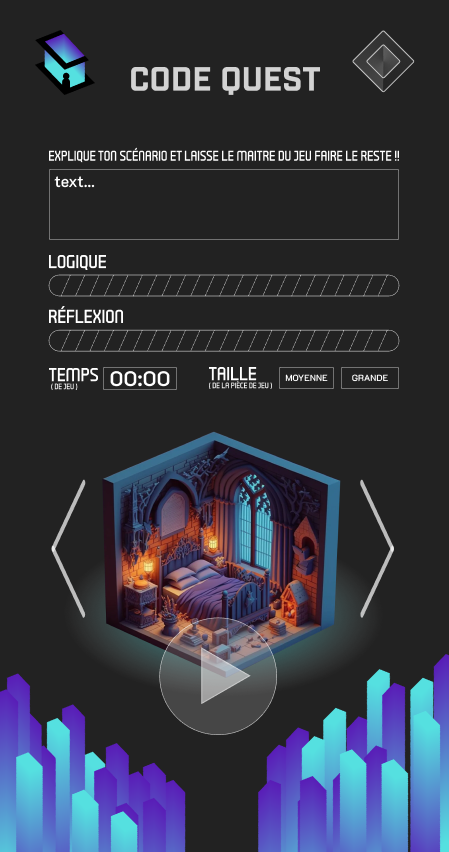
Code Quest is not a level editor. It is a forge. Five player signals are read at session start. The forge assembles a chamber pixel by pixel from a catalogue of authored beats. The result is a room that has never existed before and never will again.
The interface keeps the manuscript feel. Pixel art chambers in cool blue, violet, and pink rendered as if a medieval illuminator had picked up a CRT. The dungeon never tries to look modern. It tries to look earned.
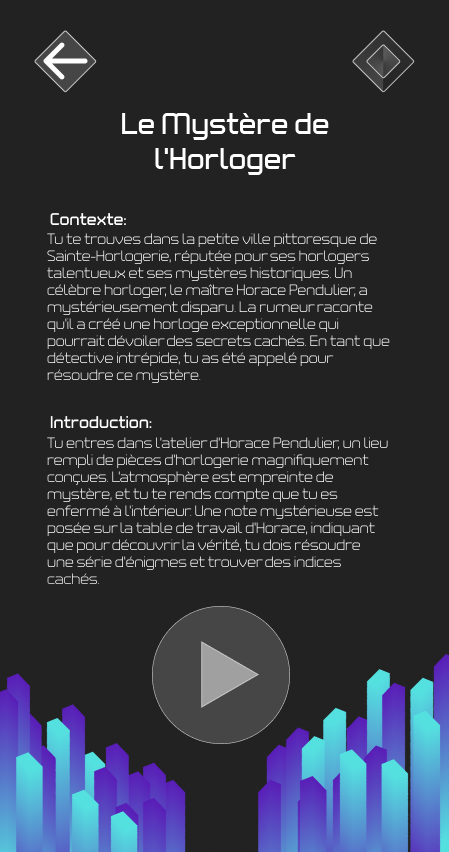
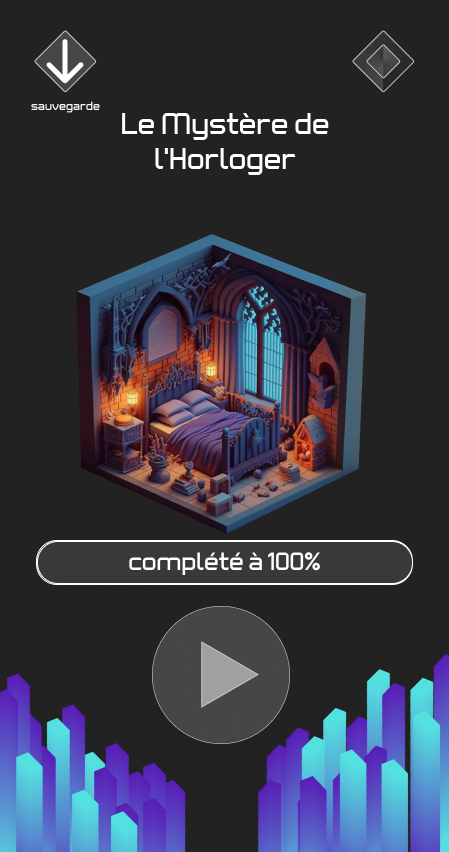
A photo essay through one quest. The same chamber seen from four moments. None of these images will exist after the player closes the door.


A player opens Code Quest after dinner. The forge reads twenty eight prior sessions, three favourite themes, a sleep aware tempo. Twenty four minutes later they are in a chamber that did not exist when they sat down.
Player opens the client. The forge wakes. Twenty eight prior sessions are pulled from the codex. No dungeon yet exists.
Mood, history, time budget, theme preference, difficulty curve. Five vectors land on the smithing bench. The bench begins to glow.
Twenty three authored beats are stitched into one isometric chamber. A blood cult riddle in a moss cracked crypt, calibrated to a 24 minute solve. The codex page is signed and sealed.
Player enters chamber one. Lore plays as ambient text on a torchlit wall. No tutorial. The room teaches itself through the smell of its own dust.
Six minutes. The forge raises the difficulty by one notch in real time, because the player is faster tonight than the codex predicted.
The dungeon dies the moment the door closes. No two players will ever solve it again. The codex remembers, the forge forgets, the player keeps the page.
Code Quest never tries to compete with open worlds. It listens to the player who has already played them, who already knows the trick, who is bored of being told the same story twice. It gives them a room born for them, dying with them.
The hardest part was not the AI. It was earning the right to not author every beat. The forge needs handcrafted fragments to feel anything. Without authored soul, procedural generation is just statistical noise wearing armour.
What stayed with me is that a quest is not a level. It is a contract between a player and a builder, signed once, broken on the way out. Code Quest is a hypothesis: that the contract is more valuable when it is signed in real time, in your name, in your own ink.
The story is not on top of the room. The story is the geometry, the light, the dust, the door.
The forge listens to tempo. The player negotiates with the chamber, never against a slider.
The forge forgets the room. The codex remembers the player. The combination is the franchise.
The model serves authored beats. It never invents from scratch. The soul stays human.
A chamber that closes is a chamber that was loved. Permanence is the enemy of meaning.